
Honorable Rector of the University of Córdoba
Honorable Vice-Rector of the University of Minho
President of the Institute of Education of the University of Minho
Distinguished Authorities
Distinguished members of the University Community
Ladies and gentlemen,
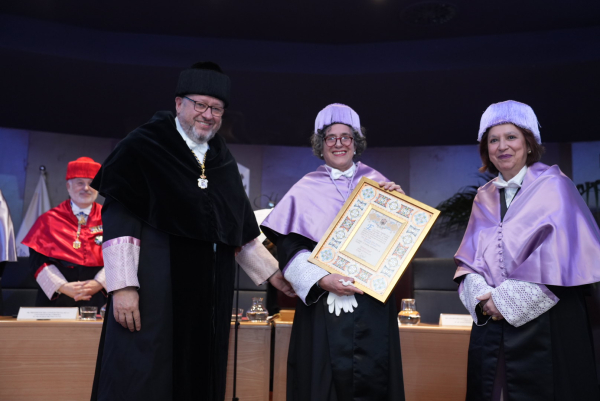
I would like to express my gratitude for the honorary doctorate awarded by the University of Córdoba, an emblematic institution in a region designated as a World Heritage Site. The historical value of this place, shaped by Roman and Arab influences and a cradle of other civilizations, is widely known internationally. It is therefore a great honor for me to be named Doctor Honoris Causa by the University of Córdoba, a university with which I have established a close and fruitful collaboration over several years through the Department of Psychology and the director of the University’s Early Childhood Intervention Center, Dr Araceli Sánchez Raya. I have observed that there are not many psychologists in the field of Special Education among those who have received this great honor and, for all these reasons, I feel threefold honored by being the recipient of this Doctorate Honoris Causa.
Following academic tradition, I begin by honoring the great mentors in my life. I am grateful to my parents, my father, a veterinary researcher, and my mother, a teacher, who, as Torga said, and I quote, formed “ties of the soul… only they gave true solidity and meaning to the fabric. They wove it with willpower and intertwined it with humanity. Thanks to these faithful and firm ties, I could now spread in the sun a cloak of fullness instead of a cloak of rags…”. My parents raised me in freedom and with a universal outlook, always supporting my initiatives without reservation. I am equally grateful to my husband, Joaquim, my companion on this journey for 31 years, whose constant and unconditional support has been essential to my personal and professional path, taking on parental responsibilities when I had to travel around the world. I am grateful to my children, who helped me redefine my role in the world, and to all the colleagues who have been part of my journey and to whom I owe an immense debt, because without them I could not have achieved the goals I set for myself – in particular the University of the Azores, where I began my academic career, and the University of Minho, an institution that offered me great opportunities, allowing me to grow and share knowledge; my PhD supervisor, Raymond Pat Gallagher; my colleagues at the Institute of Education, at the Associação Nacional de Intervenção Precoce, at the European Association of Early Childhood Intervention, which I currently chair, and at the International Society on Early Intervention; and my colleagues in the Department of Psychology and at the Early Childhood Care Centre of the University of Córdoba. All of them have contributed to the work carried out over these years, and for this I am deeply grateful.
In summarizing my career, it is important to note that from a very young age I was fascinated by young children and their development, particularly children with developmental difficulties or at risk of developmental delay. In Coimbra, where I began my work as a psychologist in an institution supporting children with intellectual disabilities, we started by creating, in 1987, the first inclusive early childhood education center for children from 0 to 3 years of age, called “Abelhinha” (Little Bee). This experience awakened our interest in early childhood intervention. My growing involvement in this field led me to want to learn more, and I embarked on an academic career, obtaining a Fulbright scholarship to pursue a Master’s degree in Early Intervention at the University of Cincinnati in the United States. Upon my return, I developed and coordinated, at the University of Minho, one of the first Master’s programs in Early Intervention in Portugal.
The scientific field of early intervention is an interdisciplinary domain that encompasses several areas of knowledge, from health and education to social welfare. Scientific advances in recent decades have yielded important contributions, particularly in the fields of neuroscience, developmental psychology, health sciences and sociology, which call for a paradigm shift in the way we approach and support the most vulnerable young children with developmental difficulties and their families.
Why is early intervention so important? Essentially for three reasons, as Guralnick pointed out in 2012. The first is pragmatic and humanitarian: to respond to the needs of families under heightened stress, focusing on aspects that support and empower them. The second concerns neuronal plasticity in the early years of life, as these constitute a window of opportunity to alter developmental trajectories, hence the need to intervene as early as possible. And finally, the third relates to the benefits of investing in the early years because, in terms of economic rationality, research has clearly shown that investments made during early childhood are economically advantageous, as they prevent the need for higher costs in the future, in addition to other later interventions in the child’s life.
From an ecological perspective, early intervention can be understood as a set of coordinated support measures from the social, educational and health sectors for children from 0 to 6 years of age and their families, aimed at improving children’s learning opportunities, strengthening caregivers’ skills and promoting family and community resources. These actions must take place in the child’s natural environments (home, nursery, preschool, etc.), during daily routines and activities, in order to promote participation in learning experiences, based on the goals defined by the family (SNIPI).
In Portugal, at the end of the 1990s, we launched a pilot early intervention project: the Integrated Early Intervention Project (PIIP), an innovative initiative. A cooperation protocol was established between the Ministries of Health, Education and Social Security of the District of Coimbra, and Local Early Intervention Teams were created in its 17 municipalities, comprising members from all three ministries (Health, Education and Social Security). This project was highly successful and was subsequently replicated, giving rise to Decree-Law 281/2009 of 6 October, which established the National Early Intervention System.
At its inception, in 2010, SNIPI supported 7,400 children, and the most recent data, from 2023, report that 27.819 children and their families are currently being supported.
Another relevant milestone in the field of early intervention was the need to train early intervention professionals. In this regard, we created a network of universities which, in collaboration with the National Association of Early Intervention (the main driving force behind the project), took part in a project of the Calouste Gulbenkian Foundation, IM2 – Intervir Mais e Intervir Melhor (IM2 – Intervene More and Intervene Better).
Within the framework of this project, in 2016 we published the book Recommended Practices in Early Intervention: A Guide for Professionals and trained a large number of professionals from Local Early Intervention Teams across the country. In parallel with these advances, my work with a team of colleagues from the European Association on Early Childhood Intervention (EURLYAID) made it possible to disseminate practices and secure recognition by European countries of the importance of our innovative integrated governance model. This led to the translation of the Recommended Practices guide into English within the framework of the European AGORA Project. It has now been translated into eleven languages, including Spanish.
The mission of Eurlyaid is to support the development of early intervention systems, disseminate evidence-based early intervention practices and promote the training of professionals in various European countries. In this regard, with the support of organizations such as the Open Society Foundations and UNICEF, we have worked to train professionals, particularly in Eastern European countries that are seeking to transition from segregated, exclusively rehabilitative and medical practices to inclusive, family-centered, strengths-based practices that empower and enable caregivers. Eurlyaid is certified as a training organization and has been carrying out intensive work in professional training and capacity building since 2020.
I would like to conclude by stating that what drives and motivates us along this path is the defense of children’s rights and the rights enshrined in the Convention on the Rights of Persons with Disabilities. It is a demanding and difficult journey, with advances and setbacks, but as Fernando Pessoa said: “Everything is worthwhile when the soul is not small.”
Finally, I would like to thank Araceli Sánchez Raya for agreeing to act as my sponsor in this long process, which has culminated in the awarding of an honorary doctorate by your university. I would also like to thank the University of Córdoba, in particular its Rector, Professor Manuel Torralbo, and all those who honors me with their presence today.
Thank you very much.